Home › Chains (AIC)
Sudoku chain (AIC) — strong and weak links
This is the technique after which no puzzle is too hard any more — and it can be learnt. A chain joins candidates through alternating strong and weak links and carries a statement from one end to the other: if this end is false, the other one is true. So at least one end is true — and every candidate that sees both ends can be eliminated, no matter which end it really is.
The general form is called an AIC, an alternating inference chain. It may mix digits and use both cell and unit relationships — which makes it the strongest technique in the toolbox. Every Titan puzzle in SudoSuite is guaranteed to contain at least one chain.
- Expert
- Needed from Titan
- Needs pencil marks
- Eliminates candidates
- Family: chains
Strong link and weak link
Everything hangs on these two terms. Both always join two candidates, not two cells.
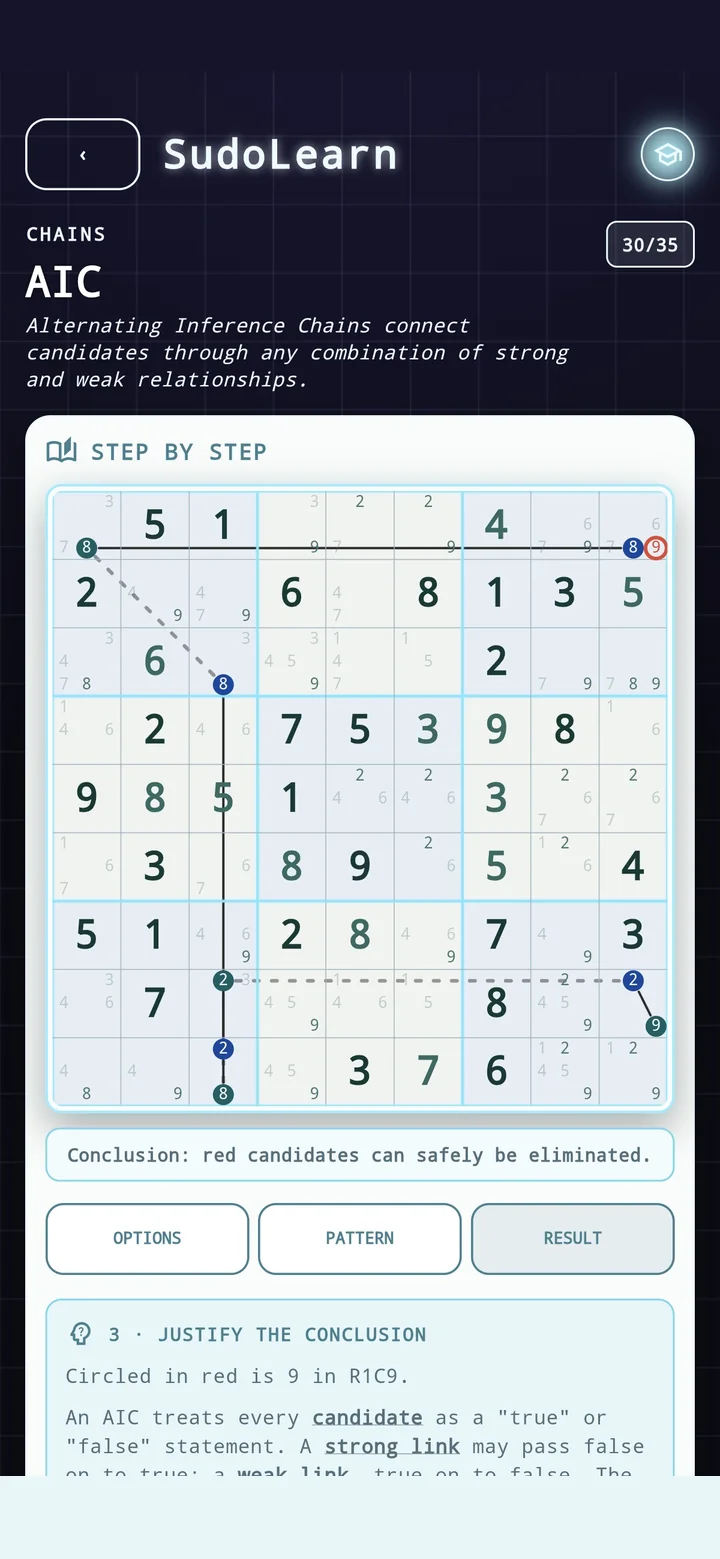
- Strong link: at least one of the two candidates is true. Typically a digit has only two places left in a unit — if one falls away, the other has to hold. A cell with exactly two candidates is a strong link in its own right. In the grid it is solid.
- Weak link: the two cannot both be true, for instance two candidates in the same cell, or the same digit twice in one unit. In the grid it is dashed.
The rule of thumb: false through strong gives true; true through weak gives false. And strong means at least one of the two, not exactly one — that mix-up is the single most common source of error.
How to spot one
- 1. Start with bivalue cells. Cells with two candidates, and digits with only two places in a unit, are the raw material of every chain.
- 2. Pick a starting candidate. Assume it is false. From there you move on through a strong link.
- 3. Alternate strictly. Strong, weak, strong, weak — never two links of the same kind in a row, and every link proven on the actual board.
- 4. Look for a suitable end. An end carrying the same digit as the start is ideal. Then either the start or the end holds.
- 5. Pick the target. Every cell that sees both ends loses that digit. If one case produces a contradiction, you may even place a digit.
Why it works
A chain does not calculate anything, it transports a statement. Assume the starting candidate is false. The first strong link turns that into a true at the next node, the following weak link turns it back into a false, the next strong link into a true again — and so on to the end. That is exactly why the link types have to alternate: each type passes on one direction only.
Two weak links in a row carry nothing, because weak only says that the two cannot both be true. Break the alternation and you break the proof — however handsome the chain looks in the grid.
At the end comes the conclusion rule: what holds in both states of the start holds for certain. If the start is true, it is true; if it is false, the end is true. Either way one end carries the digit, and a shared neighbour of both ends can never have it. Play only one case through and you have guessed. That variant with both assumptions played out is the one you may know as a Forcing Chain; the AIC is the same idea in disciplined form.
A worked example
Three cells with two candidates each: row 2 column 1 has 4 and 7, row 5 column 1 has 7 and 9, row 5 column 8 has 9 and 4. We are after the 4.
Assume row 2 column 1 holds no 4. Then this cell is the 7 — a strong link inside the cell. So the 7 in row 5 column 1 falls away, since both sit in column 1: the weak link. Row 5 column 1 therefore becomes the 9, which removes the 9 from row 5 column 8 along row 5. So row 5 column 8 becomes the 4.
At least one of the two ends therefore carries the 4. Row 2 column 8 sees both — one along row 2, the other along column 8 — and loses the 4. Which end really carries it, you do not need to know.
This form, built entirely from cells with two candidates, is called an XY-Chain and is the most common chain in practice; if everything runs on a single digit, it is an X-Chain.
Where it shows up in SudoSuite
Chains are the hallmark of the top levels: Ultra asks for two to twelve technique steps, and every Titan is guaranteed to contain at least one real chain — a Titan that can be solved without one is never shipped. More on hard Sudoku.
- Marks are what really makes the difference here: teal and blue for the two tracked states as true and false chain nodes, solid lines for strong links, dashed for weak ones. The chain then sits in the grid instead of in your head — that, not understanding, is where most people come unstuck at Titan.
- SudoLearn turns respect for chains into a staircase you can walk up: a chapter on strong and weak links alone first, then Remote Pair, Simple Colouring, X-Chain, XY-Chain and finally the AIC. The chains stay short — three to seven links, and you understand every one of them.
- SudoTrainer checks your reasoning, not just the answer. Another chain that is equally valid counts just as much — and that is what makes it a practice partner rather than an examiner.
- SudoSelect (Pro) hands you a puzzle with a guaranteed chain, whenever you want to practise one.
Common mistakes
- Losing the alternation. Two weak links in a row carry no forced truth. Note every link as strong or weak straight away.
- Reading strong as “exactly one of the two”. Strong means at least one is true. Both may be true — and the chain must not build on anything else.
- An unproven link. A digit with three places in the unit gives you no strong link, however good the line looks.
- Eliminating in the wrong place. Only what sees both ends may go. Candidates that see only one end stay.
- Reading the colours as the whole board. Teal and blue show the states along this chain, not two global truth groups. Only in Simple Colouring does one colour turn out entirely true and the other entirely false.
- Starting too long. Three provable links are worth more than nine hoped for.
Chains — as far as it goes
AIC is not another pattern but the language all the earlier ones can be written in. Once you can do chains, the rest needs no names.
- The groundwork chapter first. Chains & links explains strong and weak links — after it, Skyscraper, W-Wing and Remote Pair read like special cases.
- Lay the chain yourself. In the lesson you add link after link and see at once where it breaks. The SudoTrainer accepts other valid routes too.
- Every Titan holds one. That is not marketing but a built-in condition: a Titan that can be solved without a chain is never shipped.
Practise chains, do not just admire them
SudoLearn builds the chain link by link, SudoTrainer checks your reasoning, Marks hold it all in the grid. Then you crack your first Titan.
Common questions
What is a chain in Sudoku?
A sequence of candidates held together by alternating strong and weak links. It carries a statement through the grid: if this end is false, the other one is true. So at least one end is true.
What is the difference between a strong and a weak link?
In a strong link at least one of the two candidates is true, for instance when a digit has only two places in a unit. In a weak link the two cannot both be true, for instance two candidates in the same cell. In the grid strong is solid, weak is dashed.
Why do strong and weak links have to alternate?
Because each type can pass on one direction only: strong carries false to true, weak carries true to false. Two weak links in a row carry nothing, and the conclusion breaks off.
What may be eliminated at the end of a chain?
Every candidate that sees both ends of the chain and carries the same digit. Because at least one end is true, it collides either way. If one case produces a contradiction, you may even place a digit instead of eliminating one.
What does AIC mean?
Alternating inference chain, a chain of alternating inferences. It is the most general form: digits may change and cell and unit relationships may be mixed. X-Chain and XY-Chain are special cases of it.
From which difficulty do you need chains?
In SudoSuite at Titan. Every puzzle there is guaranteed to contain at least one real chain; one without a chain is never shipped. Ultra asks for named techniques, but not necessarily for a chain.