Home › Empty Rectangle
Empty Rectangle in Sudoku — spotting the empty area
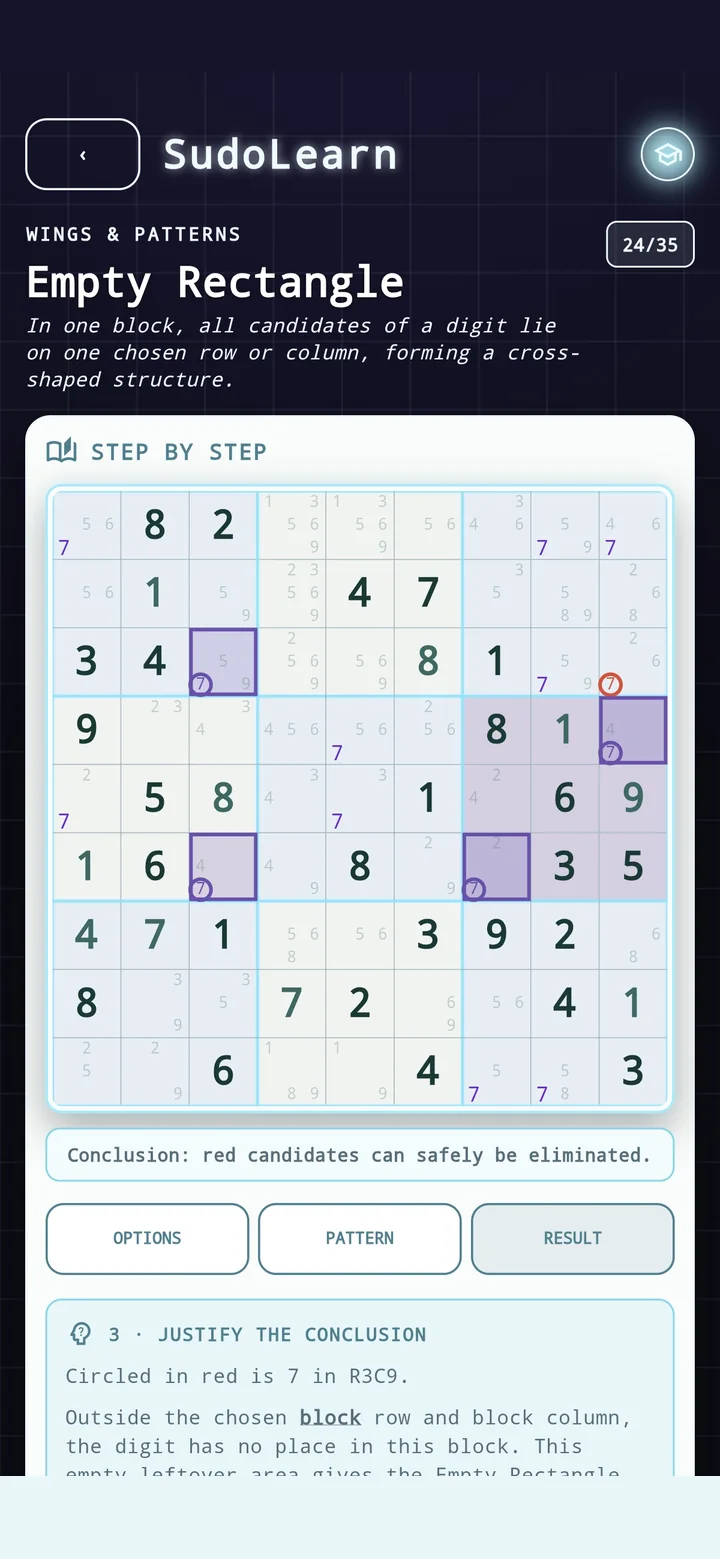
A box where one digit only sits on a cross — and out of that comes an elimination far away in the grid. That is the Empty Rectangle: every candidate of the digit inside the box lies on exactly one row and exactly one column. The cells outside the two arms are free of the digit — the empty rectangle. Together with a strong link outside the box, that gives you an elimination.
It belongs to the single-digit patterns, like the Skyscraper and the Two-String Kite — and it is the member that gets overlooked most easily. The difference: here the link is not supplied by a pair of candidates but by a whole arm of the cross.
- Advanced
- Needed from Extreme
- Needs pencil marks
- Eliminates candidates
- Family: single-digit patterns
How to spot one
- 1. Fix one digit and look only at its candidates.
- 2. Find a box with a cross shape. Every candidate has to be covered by one row and one column — the arms of the cross.
- 3. Check for at least two rows and at least two columns. Otherwise all you have is a Locked Candidate.
- 4. Look at the rectangle. The leftover area outside the arms has to be free; the intersection may hold a candidate.
- 5. Look for a strong link from outside, with one end lying on an arm.
- 6. Eliminate where the effect of the other arm and the free end of that link meet.
Why it works
Every box needs the digit exactly once. Because all its places lie on the cross, the digit sits either on the box row or on the box column. That is the trick: you do not know which arm it is, only that it is one of the two.
The link from outside hangs on one of the arms. If its free end does not carry the digit, its other end does — and that blocks this arm. Then only the other arm is left for the box, and its effect takes hold. If the free end does carry the digit, it takes effect at once. Both cases hit the same target cell.
A worked example
Take the digit 5 and the box on the right in the middle (rows 4 to 6, columns 7 to 9). There the 5 is only possible in three cells: row 5 column 7, row 5 column 9 and row 4 column 8 — all of them on the cross of row 5 and column 8. The four corner cells of the box are free of the 5: the empty rectangle. Two rows and three columns are occupied, so the condition is met.
Outside there is a strong link: in row 1 the 5 is only possible in column 3 and column 8, so the end in column 8 lies on the vertical arm. If the 5 sits in row 1 column 3, row 5 column 3 cannot carry a 5. Otherwise the 5 of row 1 sits in column 8, row 4 column 8 falls, and the 5 of the box has to lie on row 5 — which rules it out in row 5 outside the box. Either way the 5 in row 5 column 3 is eliminated.
Where it shows up in SudoSuite
From Very hard upwards a named technique is usually needed; the Empty Rectangle turns up typically from Extreme. More on hard Sudoku.
- SudoLearn builds you up to it: Pointing and Claiming first, then the strong links, then its own chapter on the Empty Rectangle — each one with an exercise right on the grid.
- SudoTrainer puts the position in front of you, on request without naming it. It checks your reasoning, not just the answer — and another valid route counts just as much.
- SudoSelect (Pro) hands you a puzzle with the Empty Rectangle guaranteed inside. No hunting, no hoping: practising.
- Marks make the cross visible — the two arms in colour first, then the outside strong link as chain nodes. In SudoP you can hunt for it with no clock at your back.
Common mistakes
- Demanding an empty intersection. The point where the arms cross may hold a candidate. Only the leftover area has to be empty — that is how SudoSuite works.
- Missing candidates outside the arms. A single one inside the empty rectangle makes the pattern invalid.
- Only one line occupied. Then it is Pointing.
- Eliminating on the wrong arm. The outside link hangs on one arm; you eliminate in the effect of the other one.
- The borderline case with two candidates. Then the arm link is an ordinary strong link. SudoLearn counts that as an Empty Rectangle, the literature usually as a Turbot Fish — the conclusion is the same.
Empty Rectangle — the box with a gap in it
This time the key is not a row but a box, where one digit occupies only a single row and a single column. It is a thing you have to see once.
- The lesson shows the empty corner. SudoLearn highlights which part of the box has to stay clear — without that picture the name stays a riddle.
- Hold it with marks. Two colours are enough: one for the box, one for the strong link pointing in from outside.
- Find it again in your own game. SudoSelect guarantees the pattern in your next puzzle, until the empty corner starts jumping out on its own.
Find the empty rectangle yourself
With SudoSelect you order exactly the pattern you want to practise — for as long as it takes until it catches your eye on its own.
Common questions
What is an Empty Rectangle in Sudoku?
A box in which every candidate of one digit sits on a cross made of one row and one column. The leftover area outside the arms is empty. Together with a strong link outside the box, that gives you an elimination.
Does the intersection of the two arms have to be empty?
No. Only the leftover area outside the arms has to be free of the digit.
What is the difference from Locked Candidates?
There every candidate of the box sits on a single line, and the elimination follows at once. In an Empty Rectangle they occupy two lines that cross — which is why a second strong link from outside is needed.
Is the Empty Rectangle part of the Turbot Fish family?
Yes, alongside the Skyscraper and the Two-String Kite. The difference: one of the two links is a grouped link inside the box instead of a single pair of candidates.