Home › Hidden Pair
Hidden Pair in Sudoku — two digits, two places
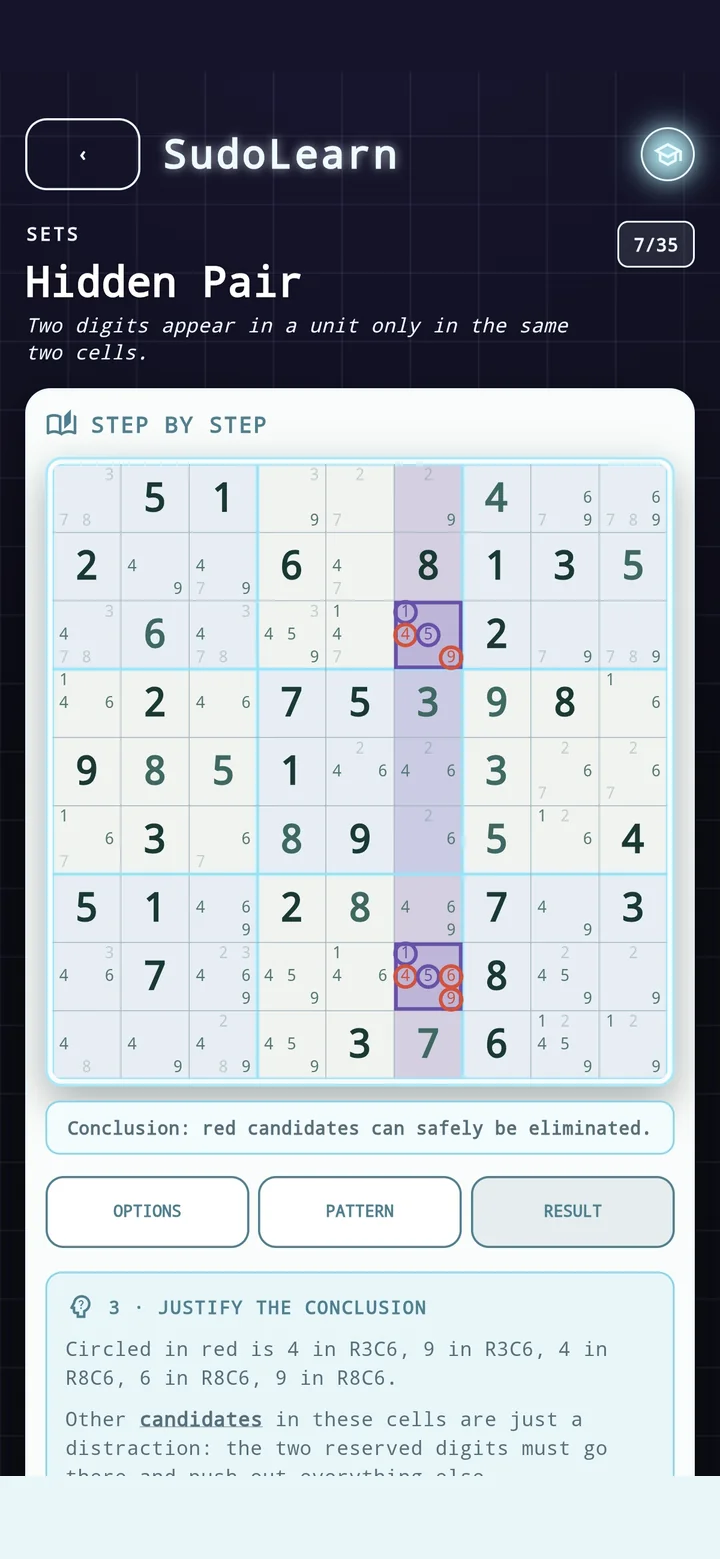
The Hidden Pair empties two crowded cells in one move — and suddenly you see what was underneath. You have one when two digits are possible, within one unit, only in the same two cells. Those two cells are then reserved for those two digits, and every other candidate in them can be eliminated — it was nothing but a distraction.
The technique is called hidden because you cannot see it in the cells: the two target cells often carry four candidates and look entirely unremarkable. The pattern only shows up once you count, digit by digit, where a digit is still allowed to go. Its counterpart is the Naked Pair.
- Basic technique
- Needed from Extreme
- Needs pencil marks
- Eliminates candidates
- Also “hidden twins”
How to spot one
- 1. Take one unit. You search in a row, a column or a box. Units with many open cells are the good ones.
- 2. Count places, do not read cells. Walk through the missing digits of that unit one at a time and note in which cells each one is still possible. Digits with only two or three places are the interesting ones.
- 3. Find two digits with the same pair of places. If two digits have exactly the same two possible cells, you have a Hidden Pair.
- 4. Clear up inside those two cells. Eliminate every other candidate there. What remains are the two pair digits — your Hidden Pair has turned into a visible Naked Pair.
- 5. Carry on. The candidates you have just eliminated are now missing from their row, their column and their box as well.
Why it works
Every digit has to appear exactly once in every unit. The first pair digit can only go into one of the two cells, and so can the second — and each of them needs a cell of its own. That accounts for both cells in full: one takes the first digit, the other takes the second. There is no room left there for a third candidate, however plausible it looks. The check that matters is the reverse one: neither of the two digits may have a third place anywhere in the unit, otherwise the pair is not proven.
A worked example
We are working in the top left box, that is rows 1 to 3 and columns 1 to 3. Among the digits still to be placed there are the 2 and the 6. The 2 is only possible in row 1, column 2 and row 3, column 3. The 6 — likewise only in those two cells. Two digits, the same two places: a Hidden Pair.
Row 1, column 2 held the candidates 2, 4, 6 and 8; row 3, column 3 held 1, 2 and 6. Because the 2 and the 6 claim those cells for themselves, the 4, the 8 and the 1 drop out. Both cells now carry nothing but {2,6}. The 4 you have just eliminated is now missing from column 2 as well — and if it only had two places there, a Hidden Single is left over.
Where it shows up in SudoSuite
From Extreme upwards the Naked Pair and the Hidden Pair belong to the toolkit the level is built for. Because the Hidden Pair is harder to see, it still turns up in the hard levels as a short cut. The full list of levels is on hard Sudoku.
- SudoLearn picks you up at the Naked Pair and walks you to the hidden one in its own chapter — with an example grid and an exercise right inside the lesson. That is where the penny drops about counting instead of looking.
- SudoTrainer puts the position in front of you without giving the name away. It checks your reasoning, not just the answer — and lets another valid route count just as much.
- SudoSelect (Pro) hands you a puzzle with the Hidden Pair guaranteed inside. You practise the technique instead of hunting for it.
Common mistakes
- A Hidden Pair is not a Naked Pair. In a Hidden Pair two digits are down to two cells; in a Naked Pair two cells are down to two candidates — there you eliminate in the rest of the unit, here inside the two cells themselves. This is by far the most common mix-up.
- Eliminating in the wrong direction. A Hidden Pair clears inside the two cells, not outside them.
- Hunting for matching cell lists. That only ever finds Naked Pairs. You find the Hidden Pair through the question “where is this digit still allowed to go?”
- Overlooking the third place. If one of the two digits is still allowed anywhere else in the unit, the pattern is invalid.
- Only searching boxes. Hidden Pairs sit in rows and columns just as often, they are simply less noticeable there.
Learning to see a Hidden Pair — the invisible sibling
A Naked Pair jumps out at you. A Hidden Pair hides behind four or five other candidates, which is why it needs practice rather than explanation.
- Both side by side. The lesson in SudoLearn shows a naked and a Hidden Pair in the same grid — that is usually where it clicks.
- Exercises, not theory. The course holds 417 exercises; the hidden patterns are the ones you sit over longest and take the most from.
- Then in your own puzzle. SudoSelect guarantees Hidden Pairs in your next game, and the pre-solved start drops you straight at the interesting point.
Learn to see Hidden Pairs
Explained, practised, then tested: SudoLearn and SudoTrainer teach you the counting. No account, offline, even with no signal.
Common questions
What is a Hidden Pair in Sudoku?
Two digits that are possible, within one row, column or box, only in the same two cells. In those two cells every other candidate can be eliminated.
Why is it called a Hidden Pair?
Because you cannot see the pair in the cells: further candidates sit there alongside it. It only shows up when you count the places each digit has left.
What is the difference between a Hidden Pair and a Naked Pair?
In a Naked Pair two cells are down to two candidates, and you eliminate in the rest of the unit. In a Hidden Pair two digits are down to two places, and you eliminate inside those two cells.
Do the two cells have to hold only two candidates?
No, quite the opposite. They may hold any number of further candidates — those are exactly what the Hidden Pair eliminates. If they only held two from the start, it is already a Naked Pair.