Home › X-Wing
X-Wing in Sudoku — how to spot it
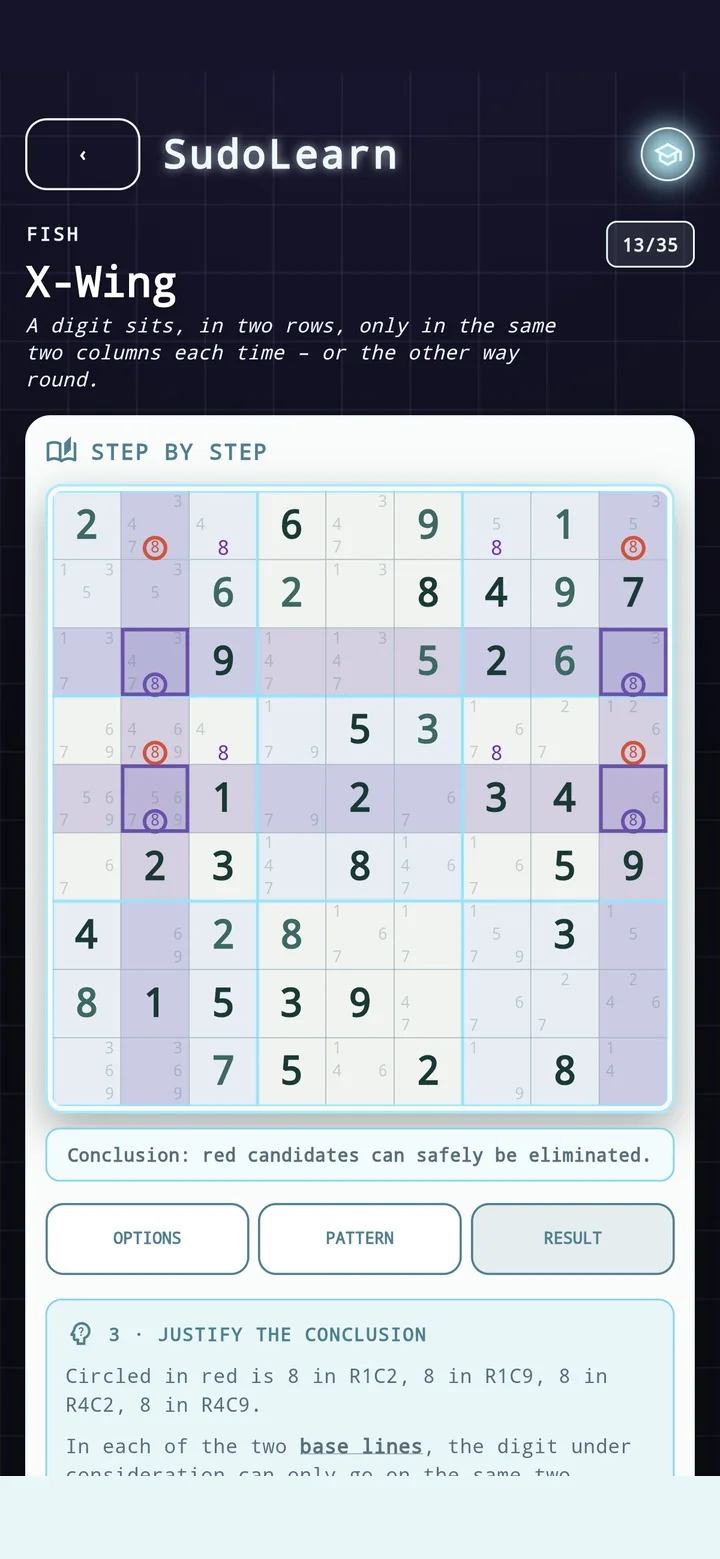
This is the technique that turns a stuck puzzle back into one that flows. In an X-Wing a digit sits, in two rows, only in the same two columns — or the other way round, in two columns only in the same two rows. The four candidates form a rectangle, and in those two columns the digit can no longer go anywhere outside the rectangle.
The X-Wing is the first technique that reasons across two lines far apart in the grid. It places no digit; it clears candidates, often in several places at once. After that, singles and Locked Candidates start working again, and the puzzle picks up speed.
- Advanced
- Needed from Extreme
- Needs pencil marks
- Eliminates candidates
- Fish family
How to spot one
- 1. Fix one digit. An X-Wing is always hunted digit by digit. Take one digit and ignore all the others.
- 2. Find base sets. Look for rows in which that digit has exactly two candidates left.
- 3. Pair two matching rows. If the two candidates of two such rows lie in the same two columns, you have the rectangle.
- 4. Eliminate. In those two columns the digit drops out of every other row — that is, everywhere except the four corners.
- 5. Search the mirror case. Then do the same with columns as the base: two columns in which the digit sits only in the same two rows. You then eliminate in those two rows.
Why it works
In each of the two base rows the digit must appear exactly once, and it must do so in one of the two columns of the rectangle. So there are only two possibilities: either one diagonal of the rectangle carries the digit, or the other does. Which of them holds makes no difference — in both cases each of the two columns gets its digit from one of the base rows. The digit is therefore excluded from every other place in those columns.
A worked example
Take the digit 6. In row 2 it is only possible in column 3 and column 7. In row 8 it is likewise only possible in column 3 and column 7. The four corners are row 2 column 3, row 2 column 7, row 8 column 3 and row 8 column 7.
If the 6 of row 2 sits in column 3, the 6 of row 8 has to sit in column 7 — and the other way round. Either way one 6 is used up in column 3 and one in column 7. So the 6 is eliminated from columns 3 and 7 in every other row, that is in rows 1, 3, 4, 5, 6, 7 and 9. Depending on how many candidates sit there, that is several eliminations in one move.
Where it shows up in SudoSuite
From Very hard a named technique is normally needed, and there it is usually still a Locked Candidate. The X-Wing is built in from Extreme, where a single technique step opens the way. In Ultra and Titan it appears together with further techniques. The full list of levels is on hard Sudoku.
- SudoLearn has its own chapter on the X-Wing — and you do not just read it, you hunt for the rectangle in the example grid yourself, with feedback on whether your reasoning holds.
- SudoTrainer puts the position in front of you, on its own if you like, and without naming it. It checks your reasoning, not just the answer — and another valid route counts just as much.
- SudoSelect (Pro) hands you a puzzle with the X-Wing guaranteed inside. No trawling, no hoping: practise it whenever you feel like it.
- Marks make the rectangle visible: four corners in colour before you eliminate anything. That alone saves you from the most common mistake.
Common mistakes
- Four corners are not enough. By far the most common error: you find a pretty rectangle but miss a fifth candidate of the same digit in one of the base rows. Then the pattern is invalid. In the base sets no further candidate may lie outside the corners — in the cover sets it may, because that is where you eliminate.
- Eliminating in the wrong direction. If rows are the base, you eliminate in the columns, not in the rows. Get that backwards and you delete the very candidates the pattern rests on.
- Confusing it with Locked Candidates. Locked Candidates compares a box and a line, the X-Wing compares two lines of the same kind. Related, but not the same.
- Only searching rows. Half the yield lies in the mirrored search across columns.
X-Wing — where Sudoku turns into a different game
X-Wing is the first technique where you stop thinking inside one unit and start thinking in four cells spread across half the grid. Players who have it crack puzzles that used to be dead ends.
- Chapter 13 in SudoLearn. X-Wing becomes necessary from Extreme upwards — and from there it shows up regularly.
- Colour the four corners. Marks hold the rectangle for you instead of your memory. The lesson shows which colour is worth using for what.
- Twenty X-Wings in a row. SudoSelect guarantees the technique in your next puzzle. There is no faster way to get a pattern into your eye.
Find your first X-Wing yourself
With SudoSelect you order exactly the pattern you want to practise — and after that you see it everywhere.
Common questions
What is an X-Wing in Sudoku?
A pattern in which a digit is possible, in two rows, only in the same two columns. In those two columns the digit can no longer go outside the four corners.
Where does the name X-Wing come from?
From the two diagonals of the rectangle: one of them carries the digit, and together they form an X. You never have to know which one it is.
Where do you eliminate in an X-Wing?
Always across the base. If two rows are the base, you eliminate in the two columns, in every row except the two base rows.
May a base row have more than two candidates?
No. In the base sets the digit must be impossible anywhere outside the four corners, otherwise the conclusion is wrong.
What is the difference between an X-Wing and a Swordfish?
The number of sets. The X-Wing uses two base sets and two cover sets, the Swordfish three and three. The idea is the same.
From which difficulty do you need the X-Wing?
In SudoSuite from Extreme. A named technique only becomes necessary from Very hard, and there it is usually still a Locked Candidate.