Home › Finned Fish
Finned X-Wing and Finned Swordfish — the fish with a fin
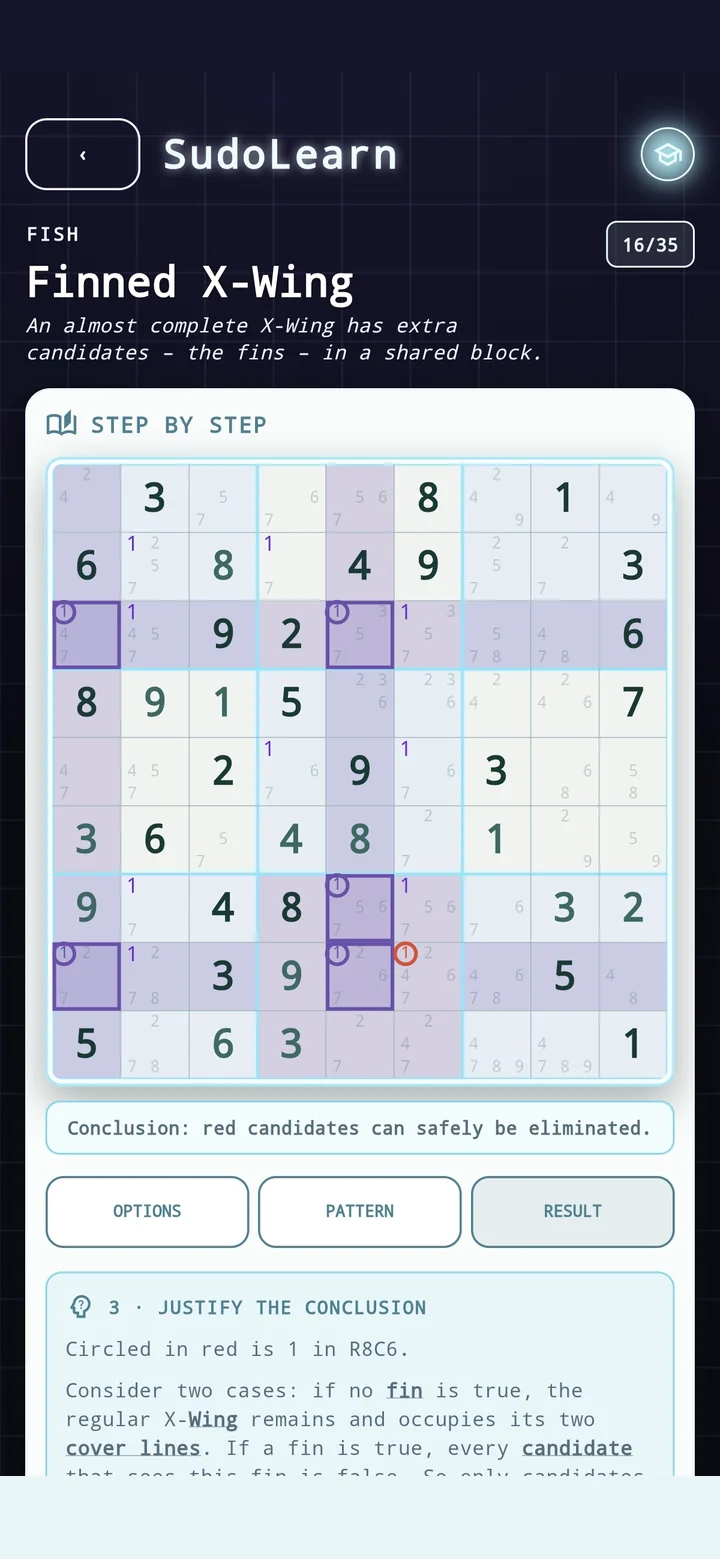
This is the technique that rescues all the fish that fail over a single candidate — and that is most of them. A Finned Fish is an almost complete fish: everything fits, except that one base set holds one candidate too many — the fin. You may then eliminate only where the elimination also holds if the fin itself turns out to be true: in the overlap of cover set and fin box.
Search for clean patterns only and you leave the larger part of the catch behind at the X-Wing and the Swordfish. You pay for it with a smaller elimination area: instead of a whole line, often only two cells are left — but exactly the ones that reopen a stalled puzzle.
- Expert
- Needed from Titan
- Needs pencil marks
- Eliminates candidates
- Fish family
How to spot one
- 1. Collect the near misses. Hunt digit by digit for an X-Wing or a Swordfish — and this time do not throw away the patterns that fail because of one spare candidate.
- 2. Identify the fin. The spare candidate has to lie in a base set, outside the cover sets.
- 3. Check the box. The fin has to share a box with a corner of that same base set, otherwise the argument does not carry.
- 4. Build the elimination area. Take the cover sets, leave out the base sets — and of what remains, keep only the cells that also see the fin. That is the overlap with the fin box.
- 5. Only then eliminate. There and nowhere else; the rest of the cover set stays untouched.
Why it works
You run two cases against each other, just as with the XY-Wing. Case one: the fin is false. Then the clean fish is left over and occupies its cover sets as usual. Case two: the fin is true. Then the digit sits there, every candidate that sees the fin is false — and the fish itself says nothing.
You do not know which case applies. So you may keep only what holds in both: the candidates that lie on a cover set outside the bases and see the fin. If that overlap is empty, the pattern yields nothing — the normal case.
A worked example
Take the digit 7. In row 2 it is only possible in column 3 and column 7 — a perfect base set. In row 5 it sits in column 3 and column 7, but additionally in column 1. Without that one candidate it would be an X-Wing. Row 5 column 1 is the fin; together with the corner at row 5 column 3 it lies in the left middle box.
If the fin were false, the 7 would drop out of column 3 and column 7 in every row except 2 and 5. If the fin is true, the 7 drops out everywhere row 5 column 1 can see. In the overlap, only row 4 column 3 and row 6 column 3 are left — both in column 3 and in the fin box. That is exactly where the 7 is eliminated, and nowhere else. Column 7 comes away empty-handed, because the fin cannot see it.
Sashimi — the fish with a missing corner
Sometimes the matching fish corner is missing entirely from the box the fin sits in: the 7 in row 5 would then only be possible in column 1 and column 7, and the corner in column 3 would no longer be there. That special case is called Sashimi.
For you nothing changes: the case split runs identically, the elimination area is the same. That is why Sashimi gets no page of its own here — once you have understood the fin logic, you recognise it in passing.
Where it shows up in SudoSuite
Finned Fish are built in at Titan, the top one of the ten difficulties. The full list of levels is on hard Sudoku.
- SudoLearn puts the Finned X-Wing and the Finned Swordfish straight behind their clean models — exactly at the moment when you are asking why the pattern did not quite fit. More than two fins never occur.
- SudoSolver makes the fin visible: fish skeleton, fin and elimination area coloured separately, with the reasoning alongside. Once seen, seen again and again.
- SudoTrainer tests the pattern on purpose and checks your reasoning, not just the answer. Another valid route counts just as much.
- SudoSelect (Pro) hands you a puzzle with a Finned Fish guaranteed inside — with a pattern this fleeting, the only way to really practise it.
Common mistakes
- Clearing the whole cover set. By far the most common error. With a fin, only the overlap with the fin box holds, not the line.
- Looking for the fin in the cover set. Any number of candidates may sit there — that is where you eliminate, after all. A fin is always a spare candidate in a base set.
- Mixing fins from two boxes. All fins have to lie in the same box, otherwise nothing is in sight of both — and so there is no elimination.
- Overlooking the clean fish. Check first whether it works without the fin. A real X-Wing eliminates more.
A fish with a fin — when the pattern almost holds
Most fish in a real grid are not clean. One cell too many and the ordinary rule no longer applies — yet part of the elimination survives anyway.
- The clean fish first. SudoLearn deliberately places Finned X-Wing and Finned Swordfish behind the plain forms; there is no shortcut past them.
- The lesson shows what survives. Which eliminations the fin spares and which it kills — marked on the grid, not explained in a paragraph.
- Titan level. Finned fish become necessary from Titan upwards. With SudoSelect you can meet them earlier if you want the practice.
Learn to see fins
Coloured apart once and the penny drops: SudoSolver shows you skeleton, fin and elimination area — with the reasoning behind them.
Common questions
What is a Finned X-Wing?
An X-Wing in which one base set holds an additional candidate — the fin. You then eliminate only where cover set and fin box overlap.
What is a fin in Sudoku?
A candidate of the same digit that lies in a base set of the fish but outside the cover sets. It shrinks the elimination area.
What is the difference between Finned and Sashimi?
In a Sashimi the matching fish corner is missing entirely from the fin's box. The reasoning and the elimination area are the same; it is just a gap in the pattern instead of a full corner.
How many fins may a fish have?
Several, as long as they all lie in the same box; in SudoSuite at most two. If they sit in different boxes, no elimination can be proven.
Why can I not eliminate along the whole cover set?
Because the fin could be true. In that case the fish does not hold, and only the cells that see the fin fall. You may keep only what is true in both cases.