Home › Unique Rectangle
Unique Rectangle in Sudoku — the rectangle that must not stand
Here you use something no other pattern uses: the fact that your puzzle has exactly one solution. A Unique Rectangle is four unsolved cells in two rows, two columns and exactly two boxes that carry the same candidate pair. If all four corners were left with only those two digits, you could swap them crosswise — the puzzle would have two solutions. Since it has only one, one corner has to take something else.
So this technique does not argue from the rules alone, but from the uniqueness of the puzzle: you eliminate candidates because the alternative would break it. Once that clicks, it is one of the finest pieces of reasoning in all of Sudoku.
- Expert
- Never required
- Needs pencil marks
- Eliminates candidates
- Assumes one solution
- Family: uniqueness
How to spot one
- 1. Look for three identical bivalue cells. Three cells with exactly the same candidate pair, for example 3 and 7 three times over.
- 2. Check the rectangle. The three cells and a fourth form the corners of a rectangle: two rows, two columns — and together exactly two boxes, not four.
- 3. No given among them. All four corners have to be unsolved cells; a fixed digit cannot be swapped.
- 4. Look at the fourth corner. It carries the pair plus at least one further candidate. That is where you eliminate.
Why it works
Suppose the fourth corner also ended up with only 3 and 7 to choose from. Then there are two ways to fill the rectangle: the 3 on one diagonal or on the other. Both spread the same digits across every row and column involved and across both boxes, just swapped around. If one fits a complete solution, so does the other — the puzzle would have two solutions.
Since it has only one, one corner has to drop out of the pair, and that can only be the corner with the extra candidate. If a single digit is left there afterwards, you have been handed a Naked Single as well.
A worked example
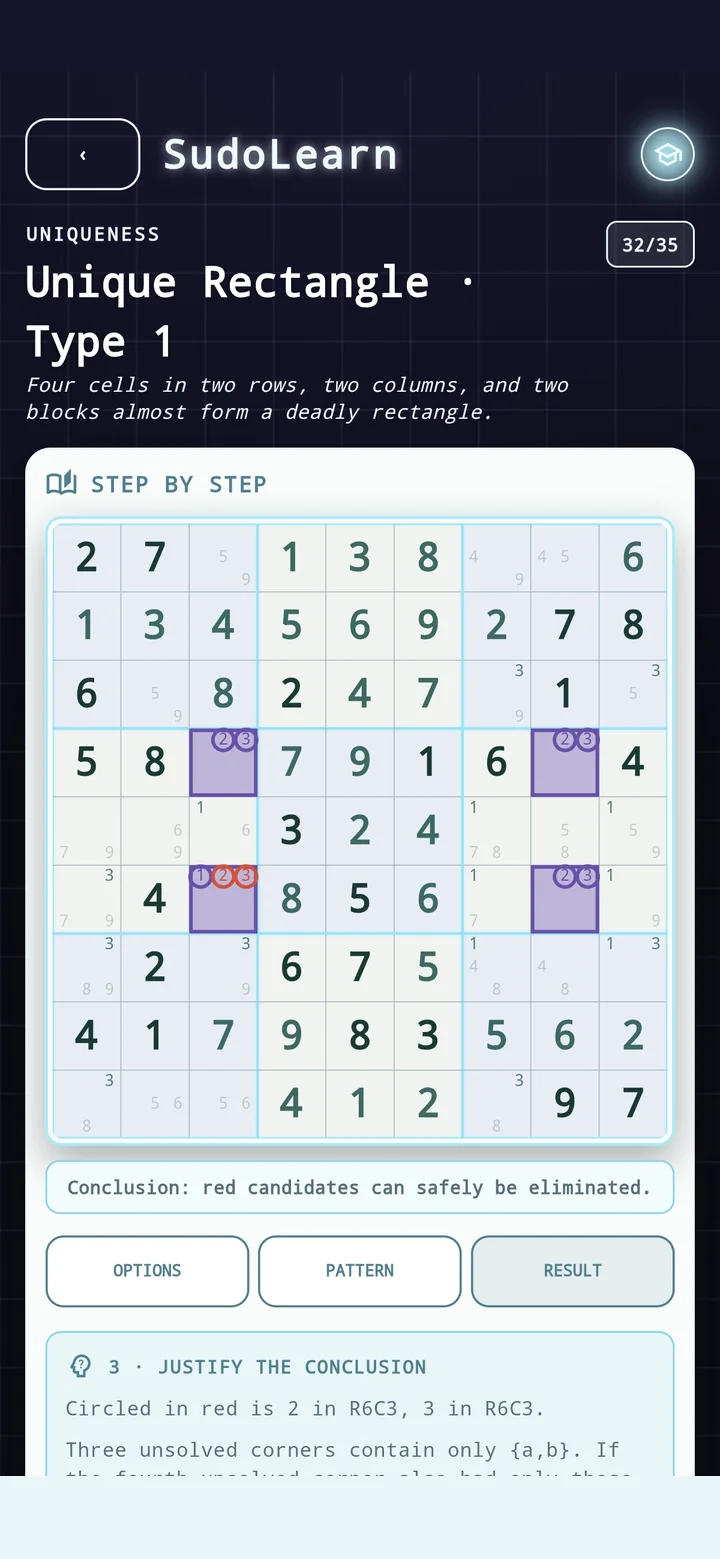
The four corners sit in row 4 and row 5 and in column 2 and column 8. Column 2 lies in the left centre box, column 8 in the right centre box — two boxes, as required. All four cells are unsolved.
Three corners carry exactly 3 and 7: row 4 column 2, row 4 column 8 and row 5 column 2. The fourth, row 5 column 8, holds 3, 7 and 9. If only 3 and 7 were possible there in the end, the rectangle could be swapped crosswise. So 3 and 7 fall away there and the cell is a 9 — two eliminations and one placed digit in a single step.
The assumption: exactly one solution
The proof stands or falls by uniqueness. In SudoSuite it is guaranteed: every puzzle has exactly one solution and passes five checks. Here you are allowed to argue this way.
With a hand-drawn puzzle from an unknown source that does not hold. If it has several solutions, you eliminate a candidate that would have been correct. That is why uniqueness techniques count as established but contested: some players only use steps that follow from the candidates alone.
Where it shows up in SudoSuite
No puzzle in SudoSuite needs a uniqueness technique. Every one of them is checked to be solvable without these patterns too — they shorten the route, but they are never the only one.
- SudoLearn first explains why you are allowed to argue this way, and only then shows the patterns: Unique Rectangle Type 1 and Type 2, Hidden Rectangle and BUG + 1. That order is what turns a trick into a technique.
- SudoTrainer leaves the uniqueness techniques out at first — you switch them on as soon as you want to practise them. Then it checks your reasoning just as it does for every other technique.
- Marks make it tangible: the four corners marked as a pattern, the elimination in the fourth corner as a red ring. You see the thought instead of picturing it.
Common mistakes
- Four boxes instead of two. The most common mistake. With the corners in four different boxes the swap is not neutral and the pattern carries nothing. Both rows must lie in the same band of boxes, or both columns in the same stack.
- One corner is a given. Fixed digits cannot be swapped. If a corner holds a given or an already placed number, the conclusion is invalid.
- Containing the pair is not the same as matching it. The three corners must have exactly the two candidates. A corner with 3, 7 and 4 does not count.
- Eliminating in the wrong cell. Only the corner with the extra candidates may lose anything, never the three pure bivalue cells.
Unique Rectangle — the technique you never need
Every SudoSuite puzzle is solvable without any uniqueness technique. The Unique Rectangle is simply the more elegant route when one presents itself.
- The idea behind it first. The Uniqueness techniques groundwork chapter explains why a puzzle with two solutions isn't a puzzle — without that, the rest is hocus-pocus.
- Type 1 and type 2 apart. SudoLearn gives each its own chapter, because they are applied differently.
- Not on the order menu. Since you never need the technique, SudoSelect doesn't list it. Which other techniques your next puzzle holds is still entirely up to you.
Understand uniqueness, do not look it up
SudoLearn explains first why these techniques need an extra assumption — and then the patterns. After that you will never look them up again.
Common questions
What is a Unique Rectangle in Sudoku?
Four unsolved cells in two rows, two columns and exactly two boxes with the same candidate pair. If all four carried only that pair, it could be swapped crosswise and the puzzle would have two solutions. That is why the pair falls away in the corner with the extra candidates.
Why may no corner be a given?
Because a given is fixed and cannot be swapped between two solutions. With a given in one corner, the argument from the deadly rectangle collapses.
Do the four corners have to lie in two boxes?
Yes. If the corners spread across four boxes the swap is not neutral and the conclusion does not hold. Either both rows lie in the same band of boxes or both columns in the same stack.
Is the Unique Rectangle allowed?
It is an established but contested technique. It is logically correct in every puzzle with exactly one solution. Some players still avoid it, because they only want to use steps that follow from the candidates alone.
Do I need the technique in SudoSuite?
No. No puzzle in SudoSuite requires a uniqueness technique; every one of them is checked to be solvable without it. It stays an optional shortcut.
What is the difference from the Hidden Rectangle?
In a Hidden Rectangle not every corner shows the pair openly as a bivalue cell. There you also need strong links to make the rectangle visible in the first place.