Home › Naked Single
Naked Single in Sudoku — how to spot it
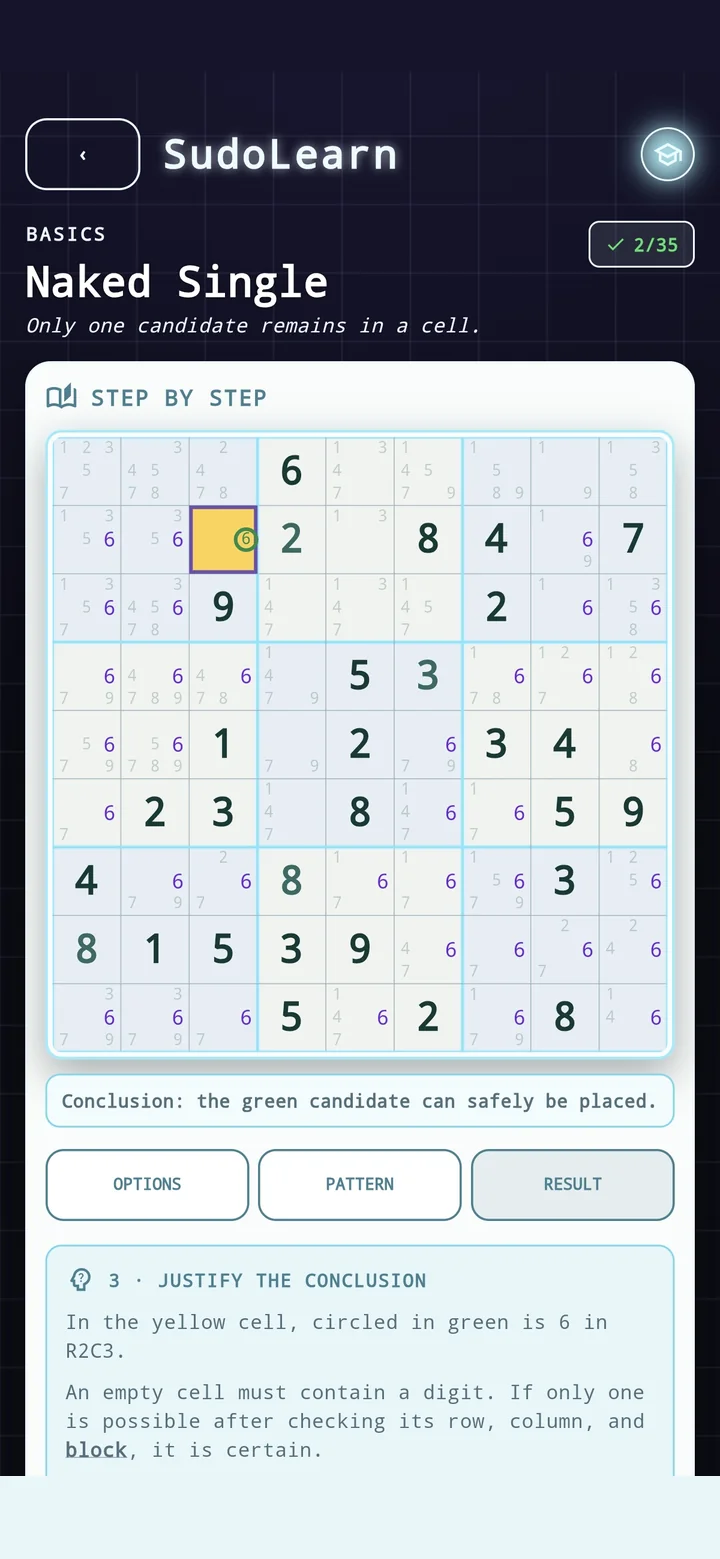
The safest move Sudoku has to offer: placing a digit without guessing. A Naked Single is a cell with only one candidate left in it. Its row, its column and its box have already used up the other eight digits — so that one digit has to go there.
Every digit you place strikes candidates somewhere else, and the next single often falls out all by itself. That is the pull that suddenly gets a puzzle running. Which is why the Naked Single is the first technique you learn — and the one you are still using on the very last cell.
- Basic technique
- Needed from Starter
- Pencil marks recommended
- Places a digit
- Also “sole candidate”
How to spot one
- 1. Pick a cell. Take an empty cell that looks short on options — the richest hunting ground is a row, column or box that is already nearly full.
- 2. Walk its three units. Which digits are already in the row, which in the column, which in the box? Every one of them is blocked for this cell.
- 3. Count what is left. If exactly one digit survives, you have a Naked Single. Write it in.
- 4. Tidy up behind you. Strike the digit you have just placed from the pencil marks of its row, its column and its box. That very often produces the next single straight away.
Why it works
Every empty cell has to hold a digit in the end — that is the basic rule of Sudoku. Which digits are out of the question is settled by the three units the cell sits in: in a row, a column and a box, each digit may appear only once. Once eight digits have been ruled out that way, a single possibility is left. There is no choice left to make, so there is no risk either. Only one thing matters: the list of exclusions has to be complete. If you have missed a digit, the single is not proven — it is guessed.
A worked example
Say you are looking at the cell in row 5, column 3. Row 5 already holds 1, 4, 6 and 9. Column 3 holds 2, 3 and 8. The middle left box also holds a 5 — and the 1 from row 5 happens to sit in that box as well.
Put together, that rules out 1, 2, 3, 4, 5, 6, 8 and 9. The only digit left is the 7. Row 5, column 3 is a 7, with nothing assumed. And it is worth looking at the neighbours right away: the fresh 7 can strike candidates elsewhere in row 5, in column 3 and in the box, and expose the next single.
Where it shows up in SudoSuite
Naked Singles carry the easy levels on their own: from Starter through to Hard you get by on singles alone. But even in Titan most of the solving path is made of singles — the hard techniques only open up the places where you are stuck. All the levels are listed on hard Sudoku.
- SudoLearn starts exactly here: its own chapter, the explanation, an example grid — and the exercise right inside the lesson, instead of somewhere down the line in a puzzle of your own.
- SudoTrainer never names the technique; you recognise it yourself. It checks your reasoning, not just the answer, and lets another valid route count just as much.
- SudoSelect (Pro) hands you a puzzle with exactly this technique guaranteed inside.
- Posips fill the candidates into the grid at the touch of a button — then you see the singles at once instead of counting through every cell. And SudoSolver gives you more than the digit for the next step: it gives you the reasoning behind it.
Easy to confuse
- A Naked Single is not a Hidden Single. With a Naked Single the cell has only one option. With a Hidden Single a digit has only one place left in a unit — and that cell is perfectly free to carry several candidates.
- Incomplete pencil marks. The most common mistake: a cell looks like a single because a candidate was forgotten when the marks went in. Only complete pencil marks turn the impression into a proof.
- Placing a digit because it looks right. “A 7 surely goes there” is not an argument. Check all three units, not just the most obvious one.
- Not clearing up after placing. If you leave the new digit standing in the neighbours' pencil marks, you miss the chain of singles that follows from it.
Spotting a Naked Single — fast, not just correctly
The rule takes ten seconds to explain. The skill is finding one in a full grid without checking every cell by hand.
- Chapter 2 in SudoLearn. Right after the rules, and for good reason: nothing moves in any puzzle without Naked Singles.
- Apply it on the spot. In the lesson you tap the cell yourself. Get it wrong and the app doesn't just say so — it shows you which candidate was still standing.
- Then play in peace. Singles are in every puzzle, so there is nothing to order. The calmest place to drill them is SudoP, with no clock at all.
Practise singles until they stick
SudoLearn explains the technique, SudoTrainer tests it — no account, offline, straight into play.
Common questions
What is a Naked Single in Sudoku?
An empty cell for which, once you have checked its row, column and box, only one single digit is still possible. That digit can be placed immediately.
Why is it called a Naked Single?
“Naked” means the candidate lies out in the open: you can see it sitting in the cell, with nothing to uncover first. In English it is also called a sole candidate.
What is the difference between a Naked Single and a Hidden Single?
With a Naked Single the cell has only one option. With a Hidden Single a digit has only one possible place in a row, column or box — and the target cell may hold further candidates.
Do I need pencil marks for Naked Singles?
Not strictly, but they are what makes the technique provable. Without complete pencil marks it is easy to miss a candidate and place a digit that only looks right.
Are Naked Singles enough for hard Sudoku?
No. In SudoSuite singles take you through to Hard. From Very hard on, a named technique becomes necessary, Locked Candidates first.