
Home › Jellyfish
Jellyfish in Sudoku — the fish with four lines
The biggest fish in the tank — and nobody forgets landing their first one. In a Jellyfish, four rows spread one digit over at most four columns in total, or, the other way round, four columns over four rows. In those four columns the digit is then ruled out in every cell outside the four base rows.
The fish family grows in steps: X-Wing works with two lines, Swordfish with three, the Jellyfish with four. The reasoning stays the same throughout — you simply have to keep one more line in view. That is where the search usually comes unstuck, and that is exactly what you can practise.
- Expert
- Needed from Extreme
- Needs pencil marks
- Eliminates candidates
- Fish family
How to spot one
- 1. Fix one digit. The Jellyfish is hunted digit by digit too. Everything else is out of the picture for the moment.
- 2. List the narrow rows. For each row, note the columns in which the digit is still possible. The interesting rows are the ones with two to four candidates — a base row may not have more.
- 3. Combine four rows. Look for four of those rows whose columns come to only four different values in total. Not every row has to touch all four; two are enough.
- 4. Count the columns, then eliminate. If there are exactly four columns, the digit drops out there in all five remaining rows.
- 5. Search the mirror case. Then do the same with four columns as the base. Half the yield lies in that direction.
Why it works
Each of the four base rows needs the digit exactly once, and each of those four occurrences lies in one of the four columns. Because no column may take the digit twice, every column gets exactly one. Which assignment holds makes no difference: all four columns are already accounted for by the base rows, and that is why the digit can no longer appear there outside them. Word for word, that is the X-Wing argument, only with four lines instead of two.
The fish family at a glance
| Technique | Base sets | Cover sets | Candidates per base set |
|---|---|---|---|
| X-Wing | 2 | 2 | exactly 2 |
| Swordfish | 3 | 3 | 2 or 3 |
| Jellyfish | 4 | 4 | 2 to 4 |
Beyond that there is nowhere left to go: in a 9×9 grid, every five-line fish always has a four-line fish in the other direction that delivers the same elimination. That is why the family ends with the Jellyfish.
A worked example
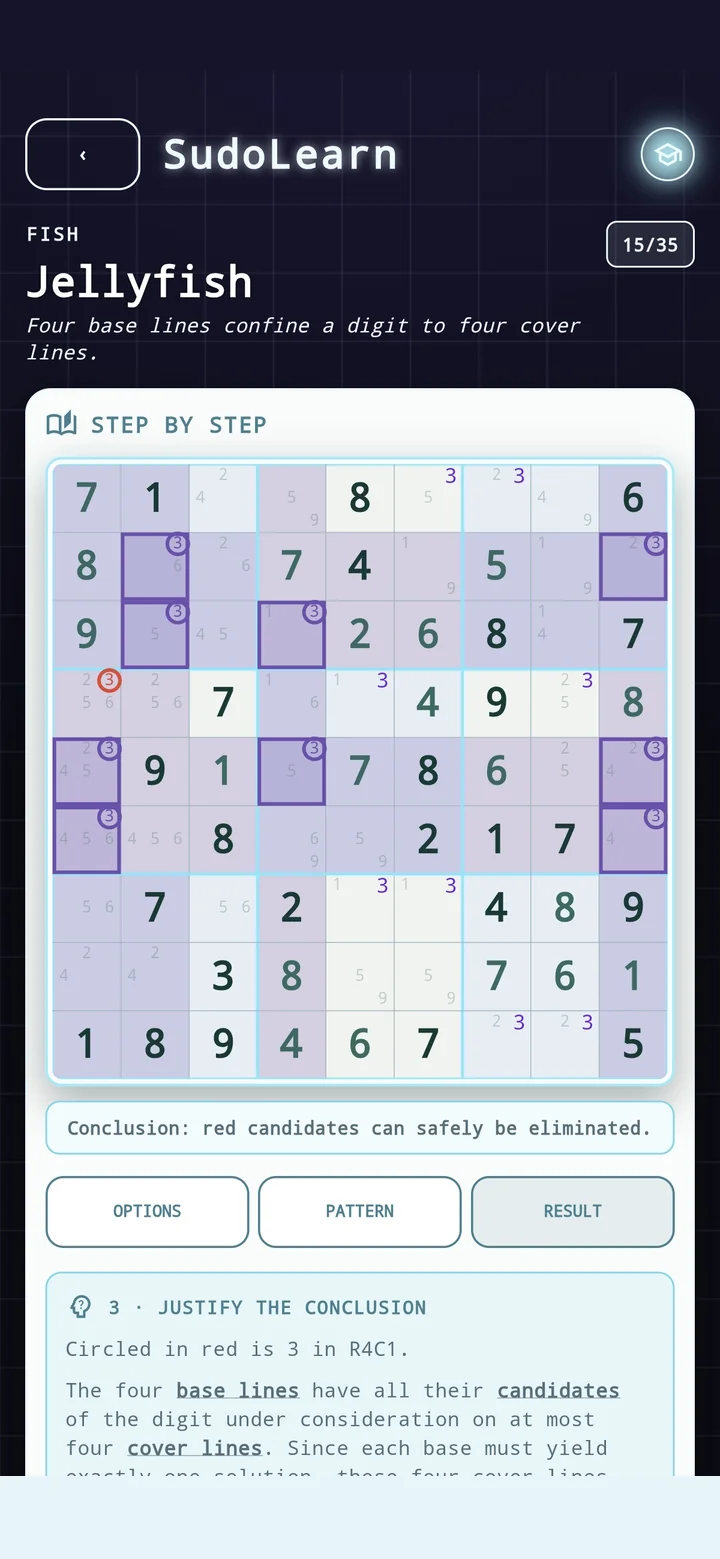
Take the digit 3. It is still possible
- in row 1 only in column 2 and column 5,
- in row 3 only in column 4 and column 9,
- in row 6 only in column 2, column 4 and column 9,
- in row 8 only in column 5 and column 9.
Together those four rows touch nothing but columns 2, 4, 5 and 9 — those are the four cover sets. No single row covers all four, which is fine. Four threes have to be spread over four columns, so every column is taken. The 3 is therefore eliminated from columns 2, 4, 5 and 9 in every other row, that is in rows 2, 4, 5, 7 and 9 — up to twenty cells in one move.
Where it shows up in SudoSuite
The Jellyfish is built in from Extreme onwards, together with the X-Wing and the Swordfish; in Ultra and Titan it stands alongside the wings and the chains. The full list of levels is on hard Sudoku.
- SudoLearn puts the Jellyfish straight after the Swordfish — so you learn it while the reasoning is still fresh. With an example grid and an exercise inside the lesson.
- SudoTrainer tests it on purpose, without naming it if you prefer. It checks your reasoning, not just the answer, and another valid route counts just as much.
- SudoSelect (Pro) is the key with the Jellyfish: you order a puzzle with one guaranteed inside. Otherwise you will hardly ever set eyes on this pattern — here you practise it whenever you want.
- Marks hold the four base sets and the four cover sets in place while you count. Four lines in your head go wrong; four lines in the grid do not.
Common mistakes
- Overlooking a fifth cover column. As soon as the four base rows touch five columns between them, the pattern is invalid. Count the columns before you eliminate — that is mistake number one.
- Insisting on four candidates per row. A base row with only two candidates is the normal case. The requirement is not that every row hits all four columns, but that no row breaks out of them.
- Selling a Swordfish as a Jellyfish. If three of the four rows already manage with three columns, you have a Swordfish — take that one, it is easier to check.
- Searching too early. A Jellyfish only pays off once singles, subsets, Locked Candidates, X-Wing and Swordfish are exhausted.
Jellyfish — rarely needed, never forgotten once seen
Four rows, four columns. A Jellyfish hardly ever comes up in ordinary play, which is precisely why most solvers never lay eyes on one unaided.
- The end of the fish line. In SudoLearn Jellyfish sits behind X-Wing and Swordfish, with all three sizes compared in the same run of chapters.
- Practice beats waiting. Waiting for a Jellyfish takes a while. The exercises in the lesson put one in front of you the moment you want it.
- Or straight into a game. SudoSelect guarantees a Jellyfish in your next puzzle. Without that, it is pure luck.
Practise the Jellyfish on purpose
Wait for one to drift by? With SudoSelect you order a puzzle in which it is guaranteed to be waiting.
Common questions
What is a Jellyfish in Sudoku?
A pattern in which four rows spread one digit over at most four columns. In those four columns the digit drops out outside the four rows. The other way round works just the same.
What is the difference between X-Wing, Swordfish and Jellyfish?
Only the number of sets. The X-Wing uses two base sets and two cover sets, the Swordfish three and three, the Jellyfish four and four. The reasoning is identical in all three cases.
Are there fish with five lines?
In theory yes, in practice no. In a 9×9 grid, every five-line fish has a four-line fish that delivers the same elimination. That is why the family ends with the Jellyfish.
Does every base row need four candidates?
No. Two or three candidates per row are fine. All that matters is that the candidates of all four rows together lie in at most four columns.
How often does a Jellyfish come up?
Rarely. In SudoSuite it is built in from Extreme, and most of the time a simpler pattern turns up first. If you want to practise it, order a puzzle with SudoSelect in which it is guaranteed to appear.