Home › Rules
Sudoku rules explained — and the first step to solving
Sudoku has a single rule, and you learn it in one sentence. Every row, every column and each of the nine boxes contains every digit from 1 to 9 exactly once. That is all the rules say — everything else follows from it.
There is no arithmetic. You look for the spot where only a single digit is left, write it in and look for the next one. The two steps of reasoning that get this going are called Naked Single and Hidden Single. Both are explained step by step below — and after that you solve your first puzzle.
- Rules in three sentences
- Naked Single
- Hidden Single
- Solvable without guessing
- Starter level to practise
The Sudoku rules in three sentences
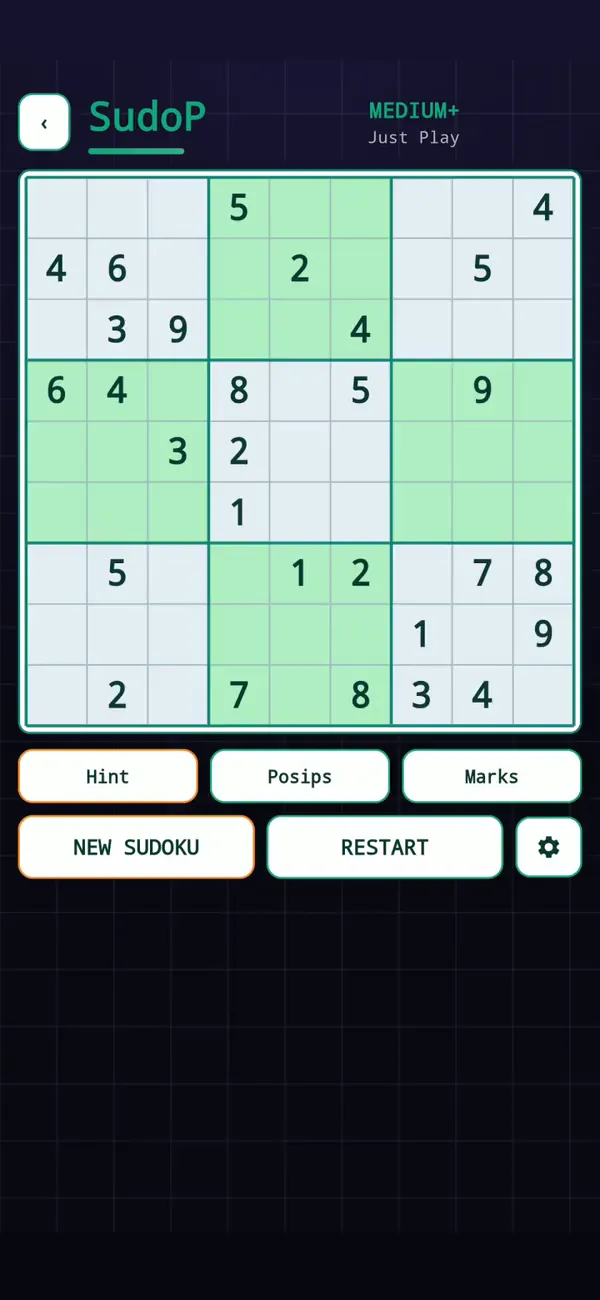
A Sudoku is a grid of nine by nine squares, so 81 cells. Thick lines also divide it into nine boxes of three by three cells. Some digits are already in the grid; these givens stay as they are.
The task: fill every empty cell so that each row, each column and each box contains every digit from 1 to 9 exactly once. No digit may repeat inside them — and none may be missing.
From that follows the third sentence: there is only one right way. Every puzzle in SudoSuite has exactly one solution and passes five checks.
One term comes up often: candidate — a digit that would still be allowed in an empty cell. In the app you write candidates in as pencil marks, on paper you use a pencil.
Just give it a go: a Sudoku, right here in your browser.
NowPlay Sudoku onlineno sign-up, no waitingNaked Single: only one digit is still possible in this cell
The Naked Single is the simplest conclusion. You look at a cell and ask what is still allowed there at all. If exactly one digit is left, that settles it. An example:
- Step 1: Pick an empty cell, ideally one with many filled neighbours.
- Step 2: Go along the row. It already holds 1, 4, 7 and 9. Those four are out for this cell.
- Step 3: The column: it holds 2 and 3. Out as well.
- Step 4: The box, that is the three-by-three square around the cell: it holds 5 and 8. Out they go.
- Step 5: That rules out 1, 2, 3, 4, 5, 7, 8 and 9 — eight digits. Exactly one is left: the 6.
- Step 6: Write the 6 in, not because it looks plausible, but because nothing else is allowed.
“Single” means: only one possibility left. “Naked” means you can see it plainly in the cell as soon as the candidates are noted. After every digit you place, it pays to look at its row, column and box: the next Naked Single often appears there right away.
Hidden Single: this digit fits into only one cell
With the Hidden Single the question turns round: not “what fits in this cell”, but “where can this digit still go in this row”. The conclusion is just as binding — you simply cannot see it by looking at the single cell. Hence “hidden”. An example with the digit 4:
- Step 1: Pick a row in which the 4 is still missing.
- Step 2: Look at the empty cells of that row — there are four of them.
- Step 3: Check each one. The column of the first already holds a 4. It drops out.
- Step 4: The second sits in a box that already contains a 4. Drops out.
- Step 5: For the third there is again a 4 in the column. Drops out.
- Step 6: One single cell is left. Since the 4 has to be somewhere in this row, that is where it belongs.
The key point: in that last cell a 2 and a 7 might also be allowed. So it has several candidates and does not look like a solution at all — that it has to be the 4 is something you see in the row as a whole, not in the cell.
The same conclusion works in columns and boxes. Go through a puzzle digit by digit once and you often find several Hidden Singles at a time.
The two most common beginner mistakes
First: guessing instead of reasoning. A properly made Sudoku can be solved by reasoning alone. If you write something in on a hunch, you often notice the mistake twenty cells later and have to take back a large part of your work. Ask yourself with every entry: can you say why nothing else could go here?
Second: not keeping the notes up to date. Candidates only help as long as they are correct. After every digit you place, cross them out in the row, the column and the box. Outdated notes are worse than none, because they lead to wrong conclusions.
How to start: the Starter level
SudoSuite has ten difficulties: Starter, Very easy, Easy, Medium, Medium+, Hard, Very hard, Extreme, Ultra and Titan. Starter is meant for the beginning — you solve these puzzles with the two singles above alone.
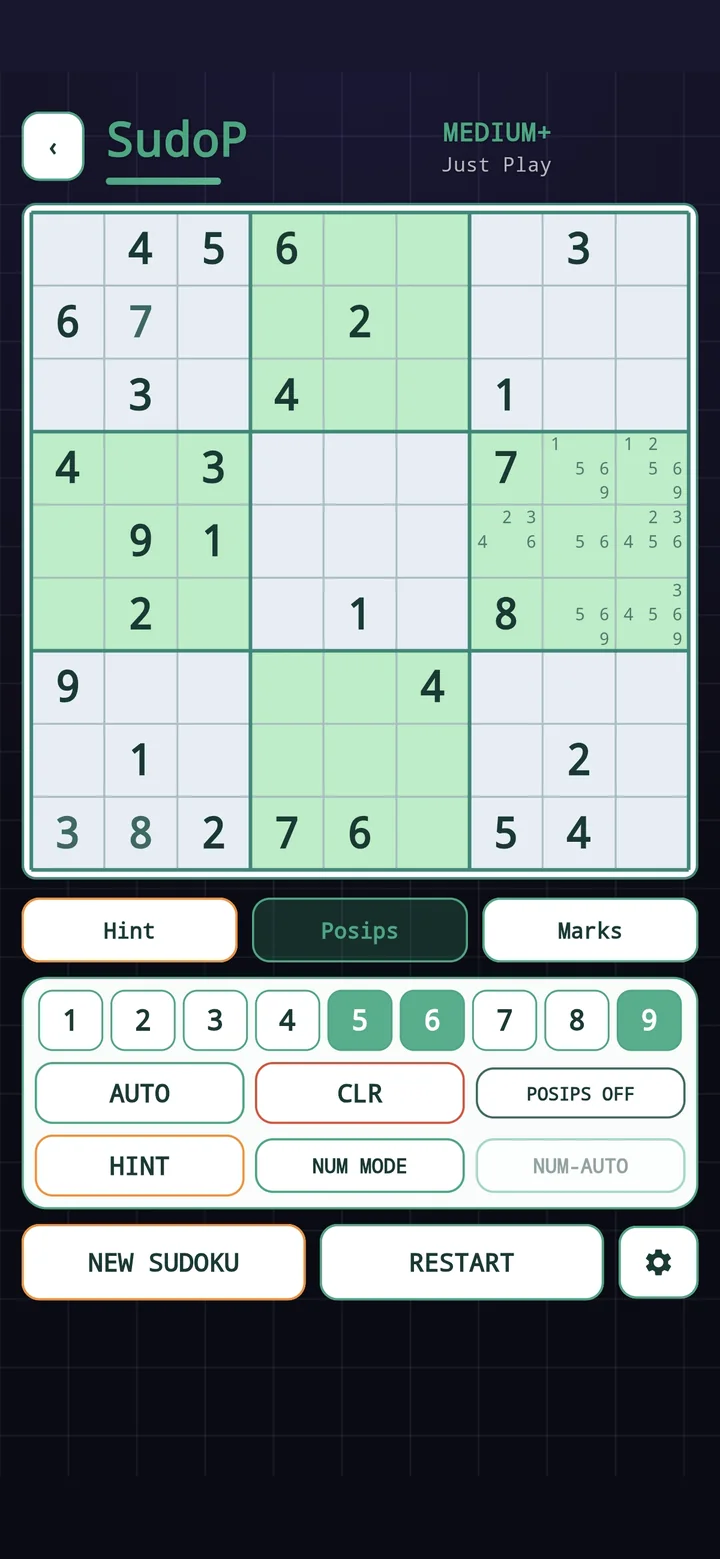
A good place to practise is SudoP, the mode without a clock: nothing is pushing you, so you can think in peace. The app takes the donkey work off your hands — it writes the candidates into the grid at the touch of a button, and on request it checks live as you go, so a mistake shows up at once instead of twenty cells later. If you want a score, you can move to SudoG later.
Only when Starter comes easily is it time for the next level. From “Very hard” upwards, singles are no longer enough, and every Titan contains at least one chain.
What comes after that
What follows the singles is in SudoLearn: 36 chapters, from Locked Candidates and the X-Wing right up to chains. Every chapter explains the pattern on a real grid and names the playing level from which it is needed.
You get tested on it in SudoTrainer. It sets up a situation and does not reveal the technique — spotting it is your job. It checks your reasoning and accepts another valid route as well.
More about that on learning Sudoku techniques; for looking things up there is Techniques A–Z.
Start with the Starter level
One rule, two steps of reasoning — and your first puzzle is under way. All ten difficulties and the whole course are included free, without an account and fully offline. Pro comes on top as an option, one payment and no subscription.
Common questions
What are the rules of Sudoku?
Every row, every column and each of the nine boxes contains every digit from 1 to 9 exactly once. The givens in the grid stay where they are, and all empty cells are filled by that rule. There is no arithmetic.
Can a number repeat in Sudoku?
Not within a row, a column or a box. Across the whole grid every digit of course appears nine times, once per row.
What is a Naked Single?
A cell in which, after row, column and box, only one single digit is still allowed. You rule out every digit that already stands in the row, the column or the box; if exactly one is left, that is the one for the cell.
What is a Hidden Single?
A digit that fits into only one single cell of a row, a column or a box. Other digits would often be possible in that cell too, but every other place for this one digit is ruled out.
Do you have to guess in Sudoku?
No. A properly made Sudoku can be solved by reasoning alone. Every puzzle in SudoSuite has exactly one solution and passes five checks. If you guess, you usually notice the mistake many cells later.
Which difficulty is right for beginners?
The Starter level. You solve these puzzles with Naked Single and Hidden Single alone. After that you move on through Very easy and Easy; from Very hard you need named techniques.