
Home › Sue de Coq
Sue de Coq in Sudoku — box and line working together
Two units tidied up in one stroke, with no case analysis and no chain — among enthusiasts Sue de Coq counts as one of the most elegant techniques of all, and with reason. A box and a line cross, and the empty cells in the intersection carry so many different candidates that two groups outside the intersection can split them exactly. One group sits in the rest of the line, the other in the rest of the box, and their candidates do not overlap.
That binds the line digits inside the line and the box digits inside the box — so they fall away everywhere else in their own unit. Counting cells and digits is all it takes. Its formal name is “Two-Sector Disjoint Subsets”; once you have found one yourself, you will only ever call it Sue de Coq.
- Expert
- Needed from Ultra
- Needs pencil marks
- Eliminates candidates
- Box meets line
How to spot one
- 1. Pick an intersection. Take the intersection of a row or column with a box and two or three empty cells in it. Starting with two is easiest.
- 2. Add up the candidates. Form the union of all candidates of those intersection cells. It gets interesting when there are two more digits than cells — two cells with four digits, three cells with five.
- 3. Look for two groups outside. One group of cells in the rest of the line and one in the rest of the box. Both groups may only hold candidates from that set, and they have to be disjoint: no digit in common.
- 4. Check the balance. The intersection cells plus both groups must be exactly as many cells as the set has digits. Only when the cell count and the digit count match exactly is it a Sue de Coq.
- 5. Eliminate. The digits of the line group fall away in the rest of the line, the digits of the box group in the rest of the box.
Why it works
Together, the cells involved are exactly as many as there are digits in the set, and none of them can take a digit from outside it. Each digit can appear at most once among these cells: the intersection cells see one another and both groups, and the two groups cannot share a digit because their candidate sets are disjoint. Four cells, four digits, each at most once — so each digit appears exactly once.
That means every digit of the line group necessarily lies in the line, either in an intersection cell or in the group itself. The same digit cannot appear in the line a second time, so it falls away in the rest of the line. For the box group the mirror image holds inside the box. Both eliminations follow from the same count.
A worked example
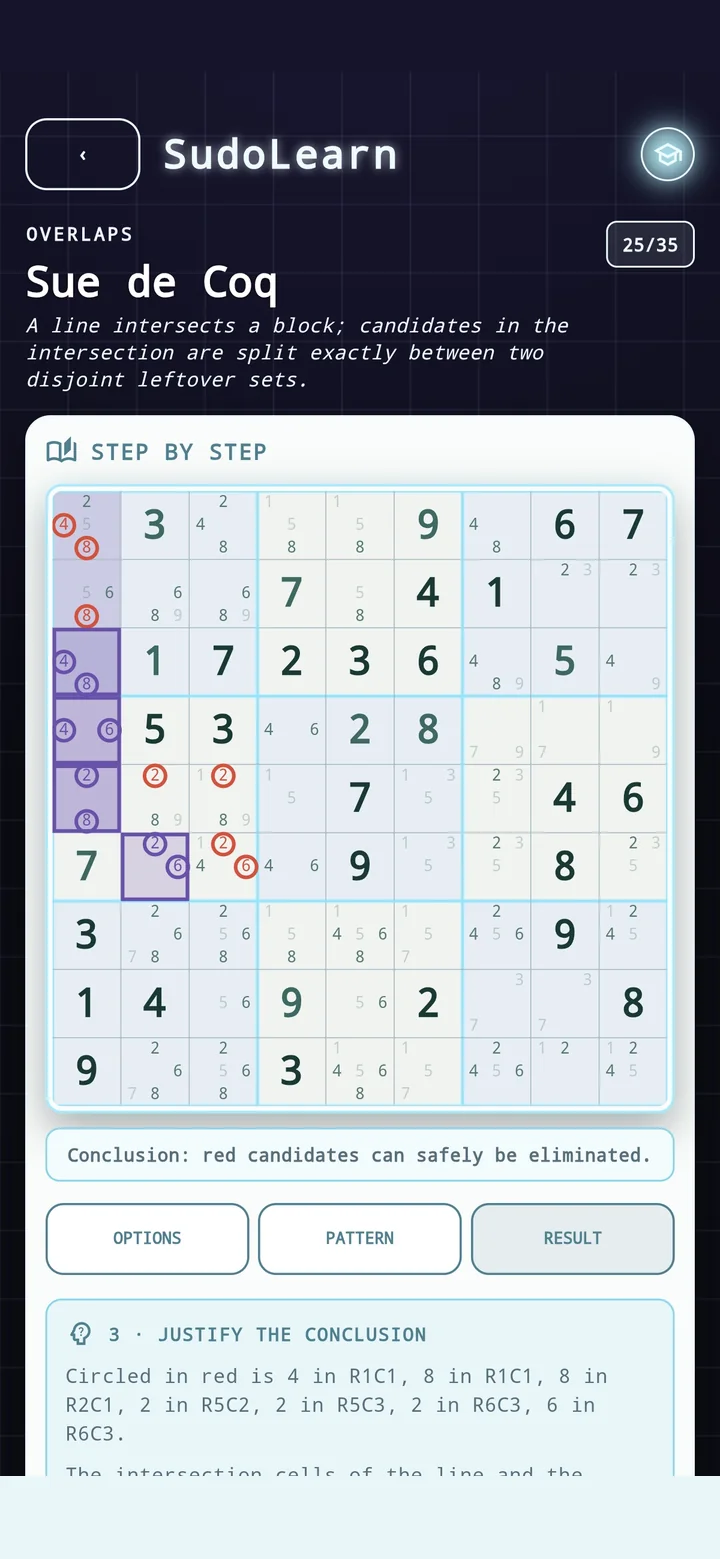
Take row 1 and the top left box. Row 1 column 1 is already solved, so two empty cells are left in the intersection: row 1 column 2 with 1 and 2 and row 1 column 3 with 3 and 4. The union is 1, 2, 3, 4 — four digits in two cells.
In the rest of the row there is row 1 column 7 with exactly 1 and 2; in the rest of the box there is row 3 column 1 with exactly 3 and 4. The two groups share no digit, and together with the intersection that is four cells for four digits. The balance is right.
So the 1 and the 2 certainly sit in row 1 column 2, column 3 or column 7 — and fall away in row 1 in columns 4, 5, 6, 8 and 9. The 3 and the 4 certainly sit in row 1 column 2, column 3 or row 3 column 1 — and fall away in the rest of the box, that is in row 2 columns 1 to 3 as well as row 3 columns 2 and 3. One single pattern, and two units lose several candidates at once.
Where it shows up in SudoSuite
Sue de Coq belongs to the upper levels: it appears in Ultra and Titan, mostly alongside fish and wings. Which level asks for which technique is on hard Sudoku.
- SudoLearn leads you there through the whole family of overlaps — Skyscraper, Two-String Kite, Empty Rectangle, then Sue de Coq. In that order it stops looking exotic and starts looking inevitable.
- SudoTrainer tests it on purpose, without giving away the name. It checks your reasoning, not just the answer; another valid route counts just as much.
- SudoSelect (Pro) hands you a puzzle with Sue de Coq guaranteed inside. With a technique this rare, that is the difference between having read about it and having found one.
- Marks keep the line side and the box side separated by colour — and you see at a glance whether the two groups overlap where they must not.
Common mistakes
- Looking at the picture instead of the balance. A striking overlap alone is not enough. The cell count and the digit count must match exactly — otherwise nothing is proven.
- The two groups overlap. If the line group and the box group share a digit, the count collapses: that digit could appear twice and another not at all.
- A group holds an outside digit. Every candidate of the two groups must come from the intersection set. One extra candidate makes the pattern invalid.
- Eliminating inside the pattern. The cells involved stay untouched. You only eliminate in the rest of the line and the rest of the box.
- Confusing it with Locked Candidates. Locked Candidates look at one digit in the intersection of box and line. Sue de Coq looks at the whole candidate set of several cells, which is why it eliminates in both units.
Sue de Coq — counting sets, not recognising shapes
Sue de Coq is not a shape you recognise but a balance you draw up. That makes it the most demanding technique in the whole course — and the most rewarding.
- The lesson counts along with you. SudoLearn lines up cells and candidates until the balance works out. As plain text it simply would not land.
- The SudoTrainer checks the argument. With Sue de Coq that is all that counts: not which digit drops, but why it has to.
- Ultra level. The technique becomes necessary from Ultra upwards. SudoSelect puts one in your puzzle on demand, instead of waiting years for one.
Find a Sue de Coq yourself
With SudoSelect you order exactly the pattern you want to practise — and see for yourself how elegantly this technique tidies up.
Common questions
What is a Sue de Coq in Sudoku?
A pattern at the intersection of box and line. The empty intersection cells carry two more digits than they are cells. If the rest of the line and the rest of the box hold two disjoint groups that split those digits exactly, the line digits fall away in the rest of the line and the box digits in the rest of the box.
Where does the name Sue de Coq come from?
Sue de Coq is the pen name of the player who described the pattern in a Sudoku forum. The formal name is Two-Sector Disjoint Subsets, because two disjoint subsets in two sectors work together.
How many cells belong to it?
Two or three empty cells in the intersection, plus one group each in the rest of the line and the rest of the box. All told there must be as many cells as the candidate set has digits.
Where do you eliminate in a Sue de Coq?
In two directions at once: the digits of the line group fall away in the rest of the line, the digits of the box group in the rest of the box. The cells of the pattern itself stay untouched.
What is the difference from a Naked Triple?
A Naked Triple lives inside one unit. Sue de Coq spreads over two units that touch in the intersection, which is why it eliminates in both.
From which difficulty do you need Sue de Coq?
In SudoSuite it appears in Ultra and Titan. Below that, fish, wings and the subset techniques are enough.